op-ed: subjective memory
When I think of Greece, three things come to mind: Mamma Mia, island beaches, and ancient ruins. I’m not really that big into musicals, nor do I enjoy uncomfortable sunburns on the beach (I can’t avoid it), so archeological history was #1 on my bucket list. While in Athens, I joined the daily pilgrimage with 20,000 other sightseers to check off “ancient ruins” and marvel at the infamous Athenian Acropolis Complex up-close.
Anticipating my internal frustration with the crowds, I opted to arrive with my online ticket at 7:00 AM, one entire hour before gates open. I’m proud to say this decision allowed me to be first in line and gave me a brief (microsecond) view of the Parthenon with nobody else in sight. I spent a while on the hill: first, an hour or so with Rick Steves in my AirPods wandering amongst the ruins. Then, as the walkways became mosh pits, sticking to a couple specific alcoves to mooch information off the official guides (standing just close enough as to not attract attention nor require those little headphone sets to hear). Combined with some time the day before in the Acropolis Museum, I feel like I have a strong understanding of the “Acropolis Narrative”.
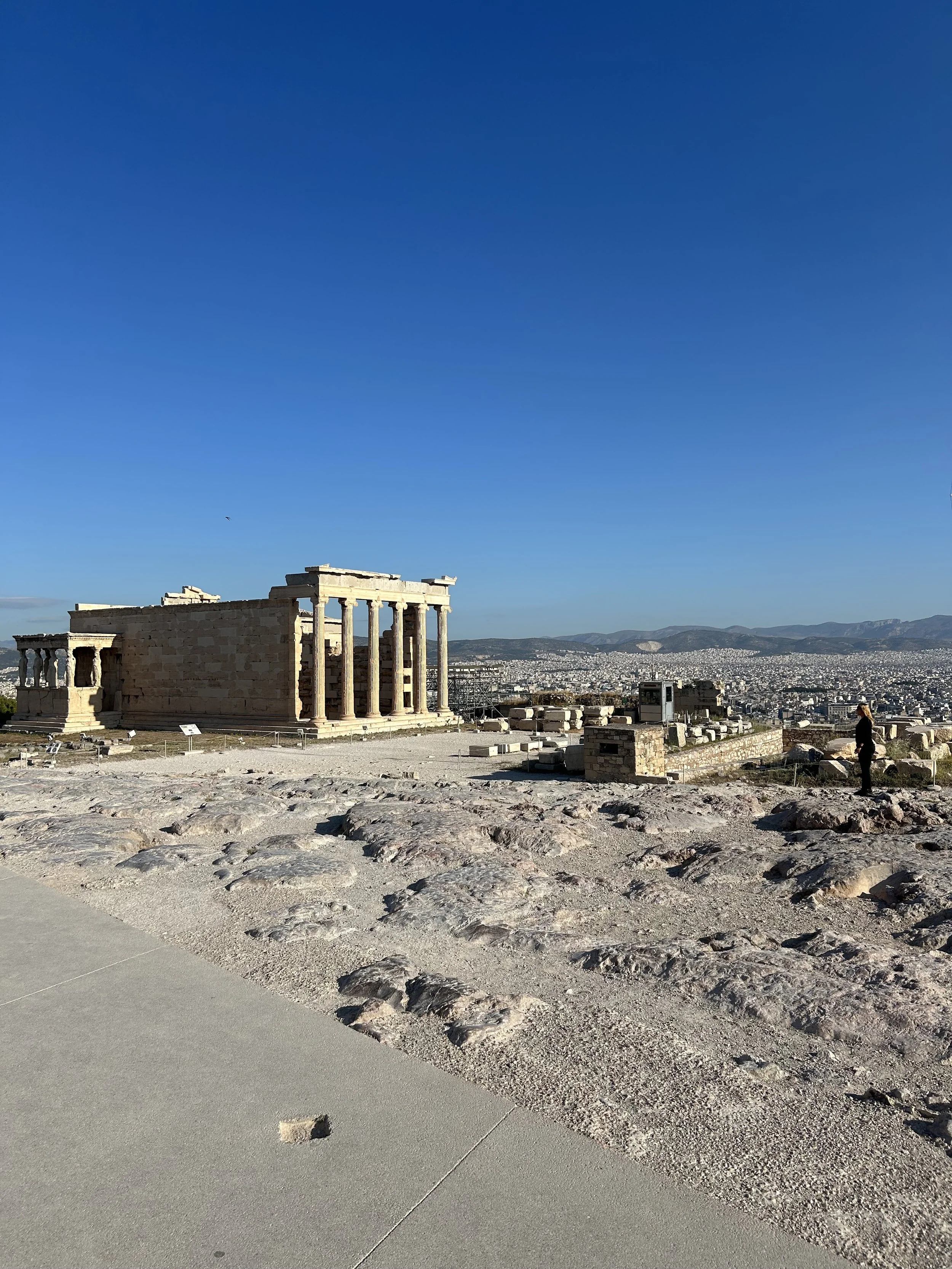
Erechtheion with no tourists!
I found myself leaving the Acropolis with questions. Not necessarily questions about the history I learned, but questions about the history I didn’t. Naturally, the Parthenon and Acropolis Complex are most recognized as the former spiritual and cultural stronghold for Ancient Greek civilizations. Sure, I agree. Fewer people know that there were actually two different Parthenons, the second of which being built atop the ruins of the first. Hm, that’s cool. Even fewer people know that between ancient times and modern restorations, the temples saw various religious transformations into Byzantine Christian churches as well as new constructions (and demolitions) of Ottoman mosques. Now THAT’S something I didn’t know— how interesting.
In my time exploring the museum and archeological site, I found it hard to find information about the Acropolis in its awkward years, those being post-antiquity and pre-restoration. The posted placards and museum-sponsored audio tours were detailed in regards to ancient Greek architecture, lifestyle, religion, and artistic practice. Then there’s extensive information about modern restoration including video footage of the process and lookouts to watch daily excavation activities. What I couldn’t find related to the Parthenon’s role and character under Byzantine, Ottoman, and early independent Greek rule. The entire museum— as well as atop the Acropolis hill— was home to artifacts from the archaic and classical periods, but I didn’t see any remnants of other craftsmanship. Where are the fragments of that Ottoman minaret that towered over Athens for 200 years? All that was displayed was an illustration. Or the centuries-old Byzantine Christian relics? Not even an illustration, just a brief blurb on the wall and brief passing comment from a guide. The museum is known to house artifacts from the entirety of the Acropolis’ history (most of which stored away from the public’s eye), but I found the layout and presentation of information to favor a specific Classical-Greek narrative.
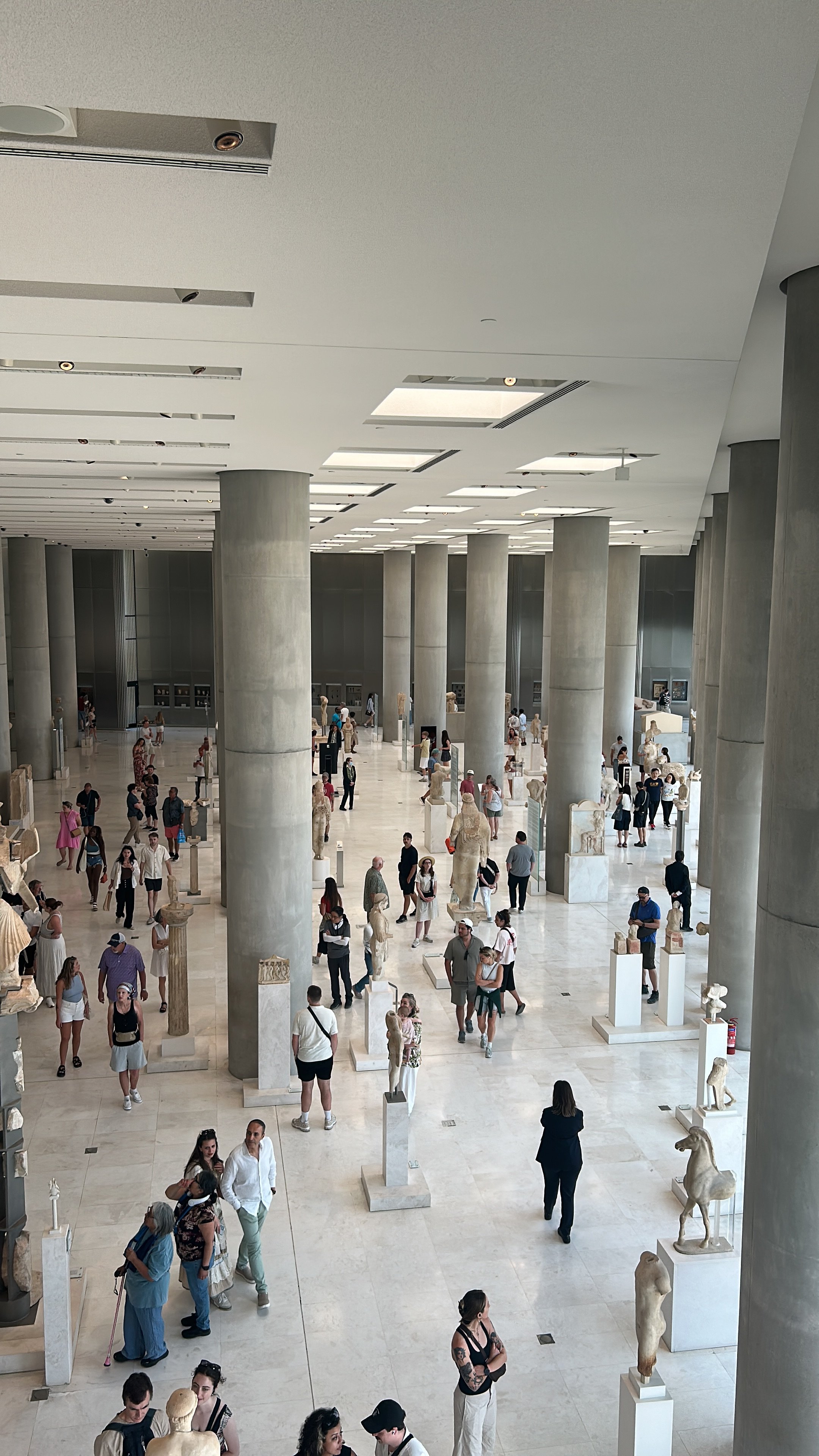
rows upon rows of ancient marble figures
Why does this matter? Visitors come expecting mythological marble creations, so what’s the problem if that’s what is displayed?
As a historical site, the Acropolis and its museum have a duty to preserve and display… well… history. But this endeavor is inherently subjective. American writer David Ebershoff describes that “even the most meticulous historians work subjectively. The historian's point of view, his or her selection of subject and sources, the emphasis, the tone - all of these lead to subjective history, inevitably so.” There is no one way to present history, and no museum curation will ever be able to fully portray every phase of the Acropolis with the respect it deserves. But my impression after visiting felt too subjective, almost playing into the imaginations and expectations of foreigners while sacrificing space for the “less desirable” artifacts.
It’s a delicate balance to strike: how does the Hellenic Ministry of Culture honor the complete history of this ancient archeological site while offering a touristic experience within the expectations of an international clientele (and their cursory understandings of Greek history)? A shift away from the classical presentation would create consequences that could reduce annual ticket earnings and inhibit costly restorations. But pander to those only wanting Doric columns and marble statues and you fail to honor the character of the site in all it’s ages.
I understand… maybe it’s too ambitious of a story to tell within one museum. There does exist another locale— the Byzantine and Christian Museum— that expands on these missing periods of Athenian history (albeit, not Acropolis-specific). But, as I said, it’s a separate building, with a separate entrance ticket. To see remnants encompassing the entire history of the Acropolis, one must visit both museums. And with such an all-encompassing name like The Acropolis Museum, you’d expect to see it all right then and there.
I know, too, that I didn’t fully explore the offerings of the museum and archeological site to answer my lingering questions. I can admit that I didn’t think to ask the knowledgable museum guides my questions nor did I read every nameplate in great detail. But I think my immediate impression leaving the site is valuable in and of itself, as it reflects that of the casual viewer. Many won’t think to wonder about these other shades of life for the Acropolis. But with the goal of preserving and displaying artifacts found in the Athenian Acropolis archeological site, I wish that the museum would strive to teach visitors about new angles of the site’s history rather than reinforcing my narrow-minded preconceptions. The museums/tours’ information briefly touched on the other lives of the Parthenon and Acropolis but did not elaborate enough to reshape my internal “Acropolis Narrative”. History museums are places I go to answer questions I didn’t know I had, but I felt the Acropolis held up on only one end of that bargain.
So, that’s my rant. It’s a wonderful museum and archeological site well worth seeing, don’t get me wrong. But I’ve found other aspects of Greek life and history that are even more wonderful. Remnants of Jewish graves scattered in church courtyards, new breakfast rituals with pastries like bougatsa, and unwavering Greek hospitality. These are things that surprised me and surpassed my expectation— things that weren’t even on my bucket list to begin with. The Acropolis just met my expectations. Checked off that #1 bucket list item. Woohoo.
I guess I’ve found that the my favorite parts of travel don’t reveal themselves until they’re experienced… they’re the things that will reshape your conceptions of happiness and success, of past and present, and of right and wrong.